
Opossum Removal in San Antonio, TX
Under the deck, in the crawlspace, or in the garage — identified, removed, and closed out.
Opossums are the most common animal people call about and the one that most often turns out not to need much. They wander, they raid whatever food is available, and a lot of the time they have already moved on by the following week. The situations that do need handling are specific: one that has denned under a structure, one in a crawlspace, or one that got into the attic. Steve will tell you which of those you actually have rather than selling you a trap for an animal that was passing through.
Opossum or Something Else?
- Sound. Slow, heavy shuffling at night. Heavier than a rat, but without the deliberate thumping and dragging of a raccoon and without any vocal chatter.
- Tracks. The clearest identifier by far. An opossum's hind foot has an opposable thumb that points out to the side, so the print looks like a small hand. Nothing else around here leaves that.
- No musk. If there is a strong musky odor, you are dealing with a skunk removal situation instead.
- Climbing. Unlike skunks, possums climb well using their tail and feet, so attic access is possible even though it is less common than with squirrels or raccoons.
- The threat display. A cornered opossum hisses, drools, bares its teeth, and may collapse into an involuntary catatonic state. It looks alarming and it is entirely bluff.
- Droppings that are larger than rodent droppings and often smeared rather than pellet-shaped.
Where Opossums Turn Up
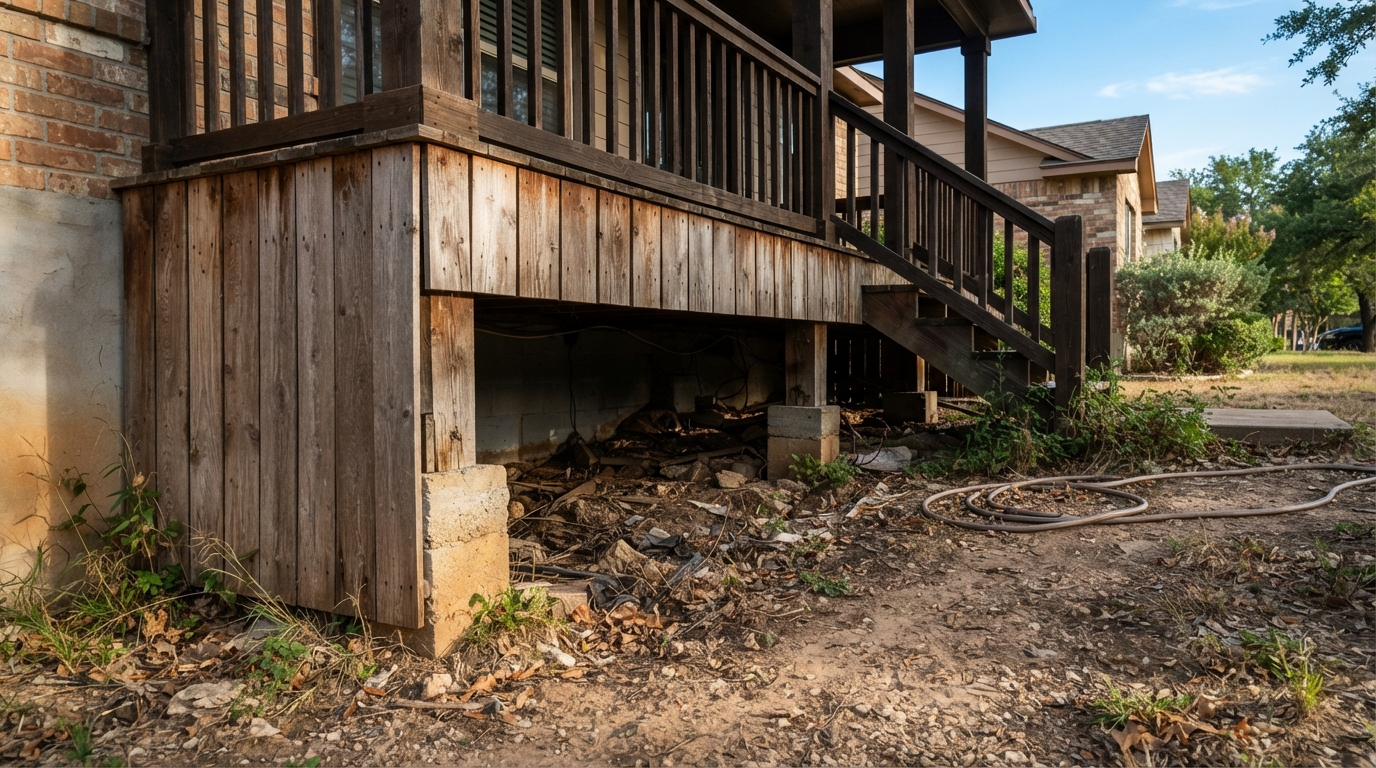
Opossums occupy ground-level gaps under decks, porches, sheds, and crawlspaces.
- Under decks, porches, and sheds
- Crawlspaces and under manufactured homes
- Garages, usually through a door left open overnight
- Woodpiles, brush piles, and dense landscaping
- Storm drains and culverts
- Attics, less often, and generally through an opening something else created
One thing that sets them apart from the other animals on this list: opossums rarely dig their own den. They occupy whatever is already available — an old burrow, a gap under a slab, a space something else opened up.
A Possum in the Attic Means Something Else Made the Hole
This is worth knowing because it changes what the job actually is.
Opossums do not chew through fascia the way squirrels do and they do not tear open soffit panels the way raccoons do. They are not built for it. If one is in your attic, it came in through an opening that already existed — which usually means a squirrel removal or a raccoon removal issue made it first, or a vent screen failed, or trim pulled away.
Removing the opossum without finding what created the opening leaves the actual problem in place, and the next animal through will be the one that made it.
The Honest Version: Possums Are Mostly Useful
Most pest company pages will not say this, but it is true and it should factor into what you decide to do.
Opossums eat ticks, roaches, snails, slugs, carrion, and small rodents. They are not territorial, they do not establish colonies, they typically live only a couple of years, and they move constantly rather than settling in. An opossum crossing your yard at night is doing more good than harm.
If one is simply passing through, or eating from a bowl of cat food you left out, the fix is often removing the food source rather than removing the animal.
When It Actually Needs Handling
That said, there are real reasons to call:
- It has denned under a structure. Droppings accumulate, odor builds, and the site attracts fleas and ticks.
- It is in a crawlspace, where contamination sits directly under your living space.
- It got into the attic, which as noted means there is an opening that needs finding.
- It is getting into the garage and into stored food, feed, or trash.
- You have pets that keep confronting it. Opossums do not start fights, but a dog that corners one can still get bitten, and the opossum usually comes off worse.
- It has died under a structure, which becomes a dead animal removal.
- You keep horses. Opossum droppings can carry an organism that causes a serious neurological disease in horses, which makes them worth taking seriously on any property with stables or feed storage.
Opossums also carry fleas, ticks, and mites, which stay behind at a den site after the animal is gone.
Babies Ride Along
Opossums are marsupials, which changes the baby-season math compared with raccoons and skunks.
The young are born extremely small, move into the mother's pouch, and stay there for a couple of months. After that they ride on her back while she moves around. Because they travel with her rather than waiting in a den, the risk of sealing dependent young inside a structure is lower than it is with the other animals.
It is not zero — older juveniles may be left at a den site while the female forages. It still gets checked before anything is closed up.
What About Rabies?
Opossums are a different case from raccoons and skunks here. Their body temperature runs lower than most mammals, which makes them a poor host for the rabies virus, and confirmed rabies in opossums is rare.
That is not a reason to handle one. The hissing and drooling display looks like a rabid animal to most people, which is exactly why it works as a bluff, and any wild animal can bite when it is cornered. Keep your distance and keep pets away.
Because opossums are not classified as a rabies vector species, the handling and relocation rules that apply to them are different from the ones covering raccoons and skunks. Steve will explain what applies to your situation.
How Steve Handles an Opossum
- Inspection. Confirming it is an opossum, finding where it is getting in, and determining whether it has denned or is passing through.
- Identifying what is drawing it in. Pet food, accessible trash, fallen fruit, or an open structure.
- Removal, where the situation calls for it.
- Finding the original opening. Particularly with attic access, since the opossum almost certainly did not create it.
- Sealing. Closing the entry and, under decks and porches, a barrier that extends below grade.
- Cleanup of the den site where droppings and nesting material have accumulated.
- Follow-up. Confirming the site is closed and nothing else has moved in.
Keeping Possums Out of the Yard
- Bring pet food inside at night. This is the single biggest factor by a wide margin.
- Secure trash containers with latching lids
- Pick up fallen fruit, pecans, and birdseed spill
- Close off the space under decks, porches, and sheds with a barrier that goes below grade
- Close the garage door at night
- Clear brush piles, wood piles, and dense ground cover near the house
- Cap the chimney and repair damaged vent screens
What Opossum Removal Costs in San Antonio
Pricing depends on where the animal is, how accessible the location is, how much exclusion work the structure needs, and whether cleanup is involved. A possum in a garage that walks out on its own once the door is open is not really a job. One denning under a slab with droppings accumulated in a crawlspace is.
Steve gives you a number after inspecting, along with what is included and what is separate.
Opossum Removal FAQ
Something Under the Deck at Night?
If you are hearing slow, heavy movement at ground level, finding hand-shaped tracks, or seeing a possum in the same spot every evening, Steve can tell you whether it has actually denned there or is just working the neighborhood — and handle it if it needs handling. For other wildlife and critter removal needs, we're here to help.