
Termite Treatment & Inspection in San Antonio, TX
Licensed inspection, honest assessment, and treatment matched to what's actually happening.
Termites are the pest people find last. They work inside wood, out of sight, and by the time damage is visible from the living side of a wall it has usually been going on a while. San Antonio sits in an area of heavy termite pressure — our clay soil, our moisture cycles, and our mild winters all favor them. The useful thing to know is that they leave signs before they leave damage, and most of those signs are findable if someone knows where to look.
Signs of Termites
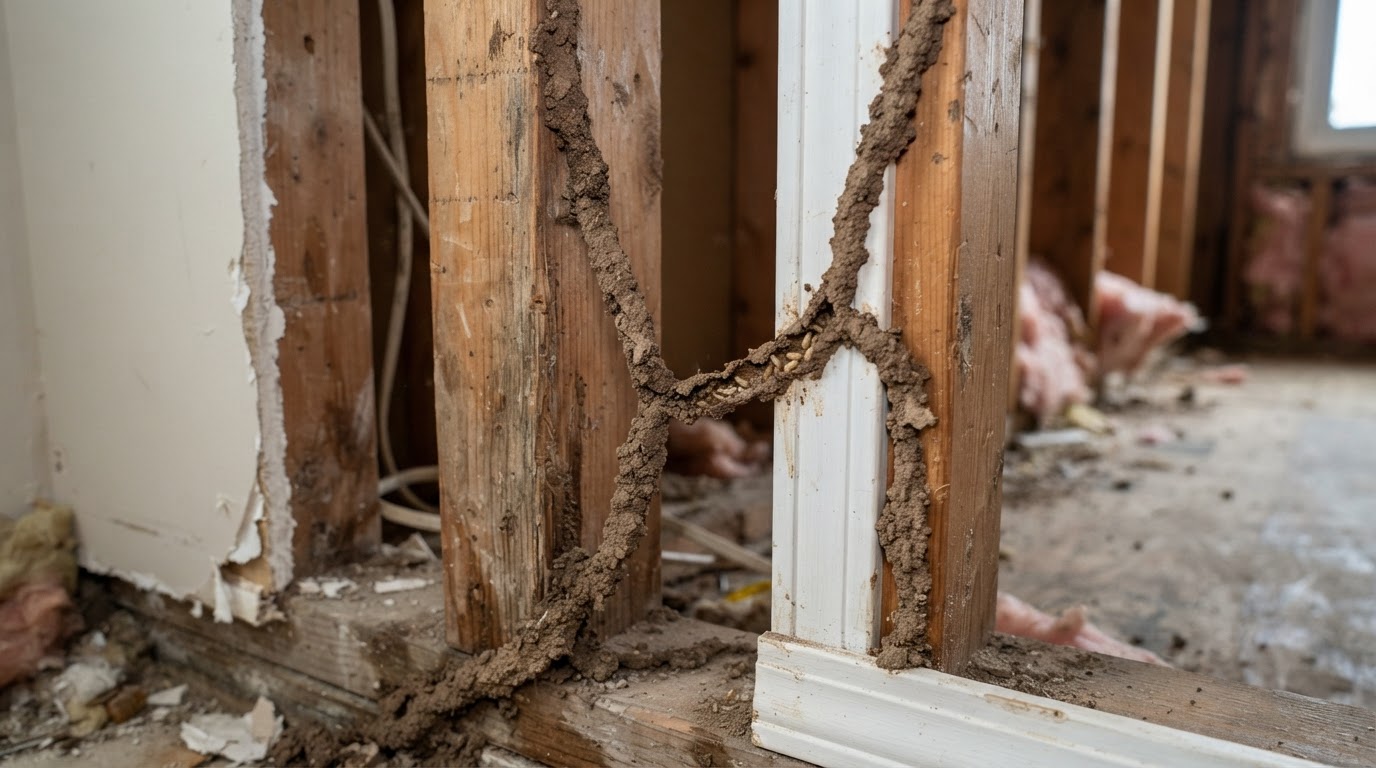
Pencil-width subterranean termite mud tubes climbing up wooden framing and trim.
- Mud tubes. Pencil-width tubes of soil running up foundation walls, piers, and slab edges. Subterranean termites build these to travel between the soil and the wood without exposure. This is the single most reliable sign.
- A swarm. Winged termites emerging inside or around the house, usually on a warm day after rain. A swarm indoors means an established colony, not a passing one.
- Discarded wings in windowsills, on floors, or near light fixtures. Swarmers shed their wings shortly after flying, and the wings often outlast the insects.
- Wood that sounds hollow when tapped, particularly around baseboards, door frames, and window trim.
- Paint that looks bubbled or rippled, or drywall with faint maze-like lines showing through.
- Doors and windows that suddenly stick, from wood swelling as galleries fill with moisture.
- Small pinholes in drywall with soil packed around them.
- Damaged wood that follows the grain, with soil packed into the galleries. This distinguishes termite damage from carpenter ant damage, which is clean and free of soil.
Termites or Flying Ants?
Every spring people find swarmers and cannot tell which they have. The difference is easy to check and it changes what happens next.
| Feature | Termite swarmer | Flying ant |
|---|---|---|
| Waist | Straight, no pinch | Clearly pinched |
| Antennae | Straight, slightly beaded | Bent at an elbow |
| Wings | Four wings, all the same length, longer than the body | Four wings, front pair noticeably longer than back |
| Wings after swarming | Shed in piles | Stay attached |
| Color | Usually dark brown to black | Varies |
If the wings are all one length and the body has no waist, it is a termite. That is worth a call.
What We're Dealing With Here
Subterranean termites
The main termite problem in San Antonio and the destructive one. They nest in the soil and travel up into structures, which is why mud tubes are the signature. They need soil contact and moisture, so anywhere wood meets ground — or where moisture keeps things damp — is where they get established. Slab foundations are not protection; they come up through expansion joints, plumbing penetrations, and cracks.
Formosan termites
A more aggressive subterranean species present in parts of Texas. Larger colonies, faster damage, and they can build nests above ground when they find a moisture source. Less common than native subterraneans here but worth identifying correctly because the response differs.
Drywood termites
Less common in this area than along the coast. They live entirely inside wood without soil contact, so no mud tubes. The sign is frass — small hard pellets that look like coarse sand or coffee grounds, pushed out of tiny holes and collecting below.
Why San Antonio Homes Are Vulnerable
- Clay soil that moves. Our soil expands when wet and contracts when dry, and that constant cycle opens cracks in slabs and around plumbing penetrations. Those cracks are the route in.
- Slab-on-grade construction. Common here, and it puts wood close to soil with limited visibility underneath.
- Mild winters. Colonies stay active through more of the year than they do further north.
- Irrigation against the foundation. Sprinkler spray keeping the soil near the slab consistently damp is one of the most common contributing conditions.
- Mulch beds against the house. Moisture retention plus a cellulose food source right at the foundation.
- Wood-to-soil contact — deck posts, fence sections meeting the house, wooden steps, and buried form boards left in place after construction.
- Drainage that runs toward the house rather than away from it.
The Inspection Is the Job
Termite treatment decisions are only as good as the inspection behind them. That means checking the whole foundation line, the slab edge, expansion joints, plumbing penetrations, crawlspaces, the garage, the attic, and the exterior conditions that create the problem in the first place.
The point of a thorough inspection is not just finding termites. It is finding whether they are active now, how far they have gotten, and what on the property is inviting them. Two houses with identical mud tubes can need different work depending on what is going on around them.
Steve is a licensed pest technician and does the inspection himself.
Termite Inspections for a Home Sale
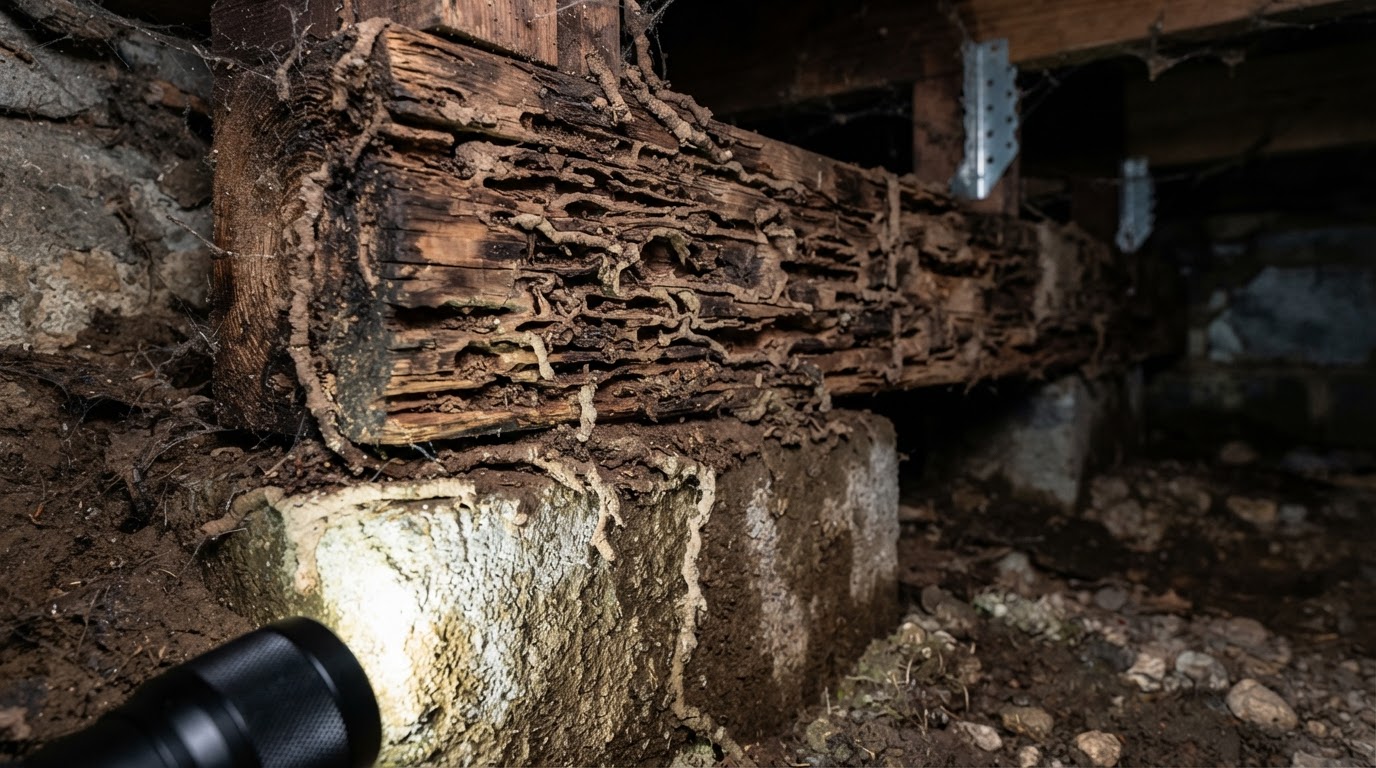
Wood destroying insect inspections evaluating wooden structural framing and crawlspace beams.
If you are buying or selling a house, the inspection that gets asked for is a wood destroying insect report. Lenders often require it — always on VA loans, and frequently on other financing — and it has to be completed by a licensed inspector on the standard form.
These are time-sensitive. They land inside a closing timeline, and a slow turnaround holds up the deal. Larger companies often schedule out further than a contract allows.
Steve handles these, and scheduling goes through him directly rather than a call center.
A few things worth knowing if you are arranging one:
- The report documents conditions found at the time of inspection. It reflects what was visible and accessible on that day.
- Findings do not automatically mean a problem with the sale. Evidence of prior activity, conditions conducive to termites, and active infestation are different findings and get treated differently by the parties involved.
- Access matters. Areas that cannot be reached cannot be inspected, and that gets noted. Clearing access to crawlspaces, attic hatches, garages, and the perimeter before the appointment makes for a more complete report.
- Timing matters more than people expect. Arranging it early in the option period leaves room to address anything that comes up rather than negotiating against a deadline.
Real estate agents: if you handle transactions in the San Antonio area and need inspections turned around inside a contract timeline, it is worth having a direct contact rather than a scheduling queue. Steve takes those calls himself.
How Termite Treatment Works
Treatment approach depends on the species, where they got in, the construction of the house, and the conditions around it. There is no single method that is right for every situation.
Broadly, the approaches are:
- Soil treatment. Creating a treated zone in the soil around and beneath the structure so termites cannot pass through it to reach wood. This is the most common approach for subterranean termites.
- Baiting systems. Stations placed in the soil around the structure that termites feed on and carry back, working on the colony rather than the individual termites. Slower, and it monitors continuously.
- Direct wood treatment. Applied to accessible wood, usually alongside one of the above rather than instead of it.
- Correcting conditions. Fixing the moisture, drainage, and wood-to-soil contact that made the structure attractive. This is not optional add-on advice — untreated conditions bring termites back.
Steve will explain which approach fits your situation and why, including what it does not cover.
Why DIY Termite Products Don't Solve It
- You cannot see the colony. The termites in the wood you found are a fraction of what exists in the soil. Treating what is visible leaves the source untouched.
- Over-the-counter products do not reach far enough. Subterranean termite treatment depends on creating continuous coverage in the soil around a structure, which is not something a hardware store product achieves.
- Spot treatment moves them. Termites reroute around a treated area rather than dying off, which means damage continues somewhere you are not looking.
- Gaps make it fail. An incomplete treated zone is not a partial barrier, it is an open door. Termites find the gap.
- The conditions stay. If irrigation is keeping the soil at the slab damp and mulch is banked against the foundation, nothing applied to the wood changes that.
Reducing the Risk
- Keep mulch and soil pulled back from the foundation, and keep weep holes clear
- Adjust sprinklers so they are not spraying the foundation
- Fix drainage that runs toward the house instead of away
- Repair leaks — under sinks, at the water heater, in irrigation lines
- Remove wood-to-soil contact where you can: deck posts, fence sections meeting the house, wooden steps
- Keep firewood off the ground and away from the walls
- Clear stumps and buried construction lumber from the yard
- Store cardboard and paper off the garage floor
- Have the structure looked at periodically rather than waiting for a sign
What Termite Work Costs in San Antonio
Pricing depends on the size and construction of the structure, the linear footage involved, the treatment approach the situation calls for, how accessible the affected areas are, and whether there is existing damage to address. An inspection on a single-story slab home and full treatment on a house with a crawlspace and active galleries are very different jobs.
Steve gives you a number after inspecting, with what is included and what is separate.
Termite FAQ
Think You Have Termites?
If you have found mud tubes on the foundation, a pile of wings on a windowsill, or wood that sounds hollow, it is worth having someone look before deciding what it means. And if you are buying or selling and need an inspection on a timeline, Steve schedules directly rather than through a call center.