
Skunk Removal in San Antonio, TX
Under the deck, under the porch, under the shed — located, removed, and dug out from under permanently.
Skunks are the one animal most people identify before they ever see it. The difference from other wildlife calls is that a skunk problem usually announces itself as a smell rather than a noise, and by the time the smell is consistent, the animal has generally moved in rather than passed through. The good news is that skunks are predictable about where they den, which makes them straightforward to solve once someone knows what to look for.
Skunks Den at Ground Level, Not in Attics
Skunks are poor climbers. If the activity is overhead, it is not a skunk — that narrows it to squirrel removal, rats, raccoon removal, or bats. Skunks want a dark, enclosed space at or below grade with a single defensible entrance.
The places they choose in San Antonio, in rough order of frequency:
- Under decks and porches, especially where skirting has come loose or the soil has settled
- Under storage sheds and outbuildings set on blocks or a slab
- Under concrete steps and slabs where the soil beneath has eroded
- Crawlspaces
- Under manufactured and mobile homes
- Woodpiles and brush piles
- Abandoned burrows dug by something else
- Under HVAC pads and pool equipment platforms
Signs You Have a Skunk
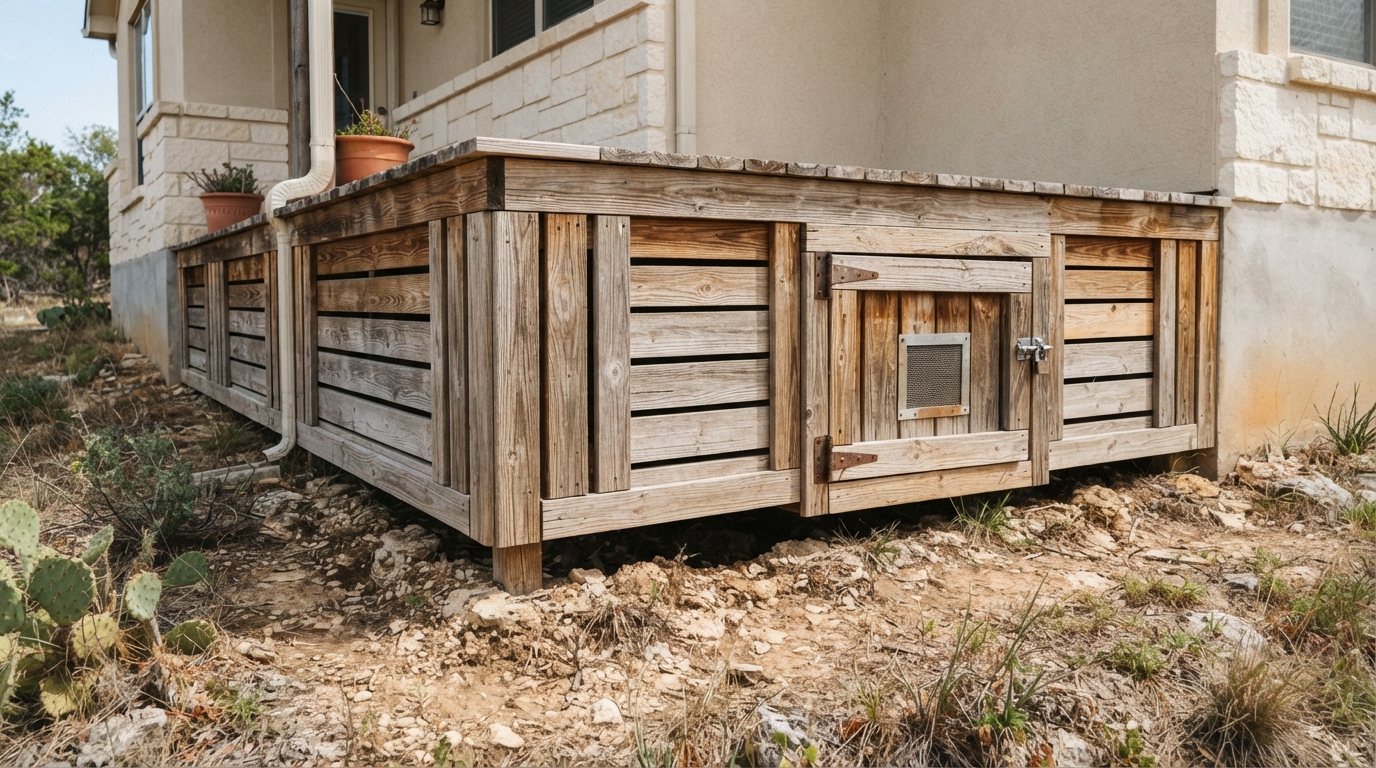
Skunks typically enter and den in ground-level openings beneath deck skirts, porches, and sheds.
- A persistent low-level musky odor that is present without anything having been sprayed. Skunks carry a background scent, and a steady smell near a deck usually means denning rather than an incident.
- A hole at the edge of a deck skirt, foundation, or slab, typically six to eight inches across with loose soil fanned out in front of it.
- Small cone-shaped divots in the lawn, usually three to four inches across, from digging after grubs.
- Tracks showing five toes with long claw marks on the front feet.
- Droppings containing visible insect parts and seeds.
- Nighttime ground-level activity — rustling and digging rather than anything overhead.
- A pet that has been sprayed, which usually means the skunk is denning close by rather than passing through.
Those Cone-Shaped Holes in Your Lawn
Lawn damage is often the first thing a homeowner notices, and it gets blamed on the wrong animal constantly. Three animals dig for grubs here and they leave different evidence:
- Skunks make small, neat, cone-shaped divots, roughly three to four inches across and shallow.
- Armadillos dig larger and deeper, and root around rather than making tidy holes.
- Raccoons peel back sections of sod like rolling up carpet, leaving flaps rather than holes.
If the digging is skunk damage, there is a second thing worth knowing: they are there because the grubs are there. Dealing with the animal without dealing with what is drawing it means a new skunk finds the same lawn next season. That part crosses over into general pest control rather than wildlife removal.
Kit Season
Skunks breed in late winter and their young are born in spring. Kits stay in the den for roughly two months before they are mobile enough to follow the female out at night.
Through that stretch, sealing off a den entrance without checking traps the young underneath your deck or slab. There is no version of that outcome that is not worse than the original problem, and it is considerably harder to resolve once it has happened.
Confirming whether kits are present comes before anything gets closed.
What a Skunk Does Before It Sprays
Skunks are far more reluctant to spray than their reputation suggests. Their supply is limited and takes days to rebuild, so spraying is a last resort rather than a first response.
They give warning first, in a fairly consistent order: stamping the front feet, raising and fanning the tail, hissing, and turning so the back end faces the threat. If you see any of that, back away slowly and give the animal room. Most people who get sprayed either startled a skunk at close range or cornered one that had nowhere to go.
Do not approach a den entrance to look inside, and keep dogs away from it — a dog that pushes its head into a den is the most common way this goes badly.
Getting the Smell Out
Tomato juice does not work. It masks briefly and then you have a wet animal that smells like skunk and tomato.
What actually breaks down the compounds is a mixture of hydrogen peroxide, baking soda, and a small amount of dish soap, worked into the fur or fabric and then rinsed thoroughly. A few things worth knowing before you use it:
- Mix it fresh and use it immediately. Do not make it ahead or store it in a sealed container.
- Keep it away from eyes, nose, and mouth. If a pet took a direct hit to the face, call your veterinarian rather than treating it yourself.
- It can lighten fabric and fur, so test somewhere inconspicuous first.
- Wash outdoors if you can. Bringing a sprayed animal inside spreads the odor through the house.
For odor in a crawlspace or under a structure, the smell will not fully clear while the animal is still denning there. Removal comes first.
What Actually Happens to the Animal
Skunks are among the primary rabies vector species in Texas, and the state restricts transporting and relocating them. A company cannot legally trap a skunk under your deck and release it somewhere else. Anyone describing it that way on the phone is not describing what actually happens.
Steve will explain the options for your situation directly before any work begins.
Health and Safety
Skunks are a rabies vector species in Texas. A skunk that is out in daylight, moving unsteadily, behaving unusually boldly, or showing no wariness around people warrants distance and a phone call rather than a closer look. Normal skunk behavior is nocturnal and avoidant.
Keep pets away from any den entrance, and keep unvaccinated dogs away entirely. If a person or pet has been bitten or scratched, contact a doctor or your veterinarian promptly rather than waiting to see what develops.
Skunks also carry fleas and ticks, which remain in the den site after the animal is gone.
How Steve Handles a Skunk
- Inspection. Locating the den entrance and confirming it is a skunk rather than an opossum, armadillo, or something else using the same space.
- Checking for kits. In spring and early summer this determines the sequence of the entire job.
- Removal, using an approach suited to the den location and structure.
- Dig-proof exclusion. Skunks dig, so a barrier that only closes the visible opening fails. Effective exclusion extends below grade and turns outward so the animal cannot simply tunnel under it.
- Odor attention where the den site needs it.
- Identifying what drew them in — grubs in the lawn, accessible pet food, unsecured trash, or open space under a structure.
- Follow-up. Confirming nothing has reopened the site.
Keeping Skunks From Coming Back
- Close off the space under decks, porches, and sheds with a barrier that extends below grade rather than surface skirting alone
- Bring pet food inside at night, including outdoor cat feeding stations
- Secure trash containers with latching lids
- Clear brush piles, wood piles, and stacked material near the house
- Fill eroded voids under steps, slabs, and equipment pads
- Address grub populations in the lawn, since that is often the actual attraction
What Skunk Removal Costs in San Antonio
Pricing depends on where the den is and how accessible it is, whether kits are present, how much exclusion work the structure needs, and whether odor treatment is involved. A skunk under an open deck is a different job than one denning under a slab where the soil has washed out.
Steve gives you a number after inspecting, with what is included and what is separate.
Skunk Removal FAQ
Smell Something Under the Porch?
A steady musky odor around a deck or shed, a fresh hole at the skirting, or cone-shaped divots appearing in the lawn all point the same direction. Steve can confirm what is under there, check whether there are kits, and close it off so nothing moves back in. For other wildlife and critter removal needs, we're here to help.