
Rodent Control in San Antonio, TX
Find how they're getting in, trap where they actually travel, and seal the house with steel.
Most people picture a rat as a ground-level animal that comes up from a sewer. In San Antonio that is usually the wrong picture. The rodent in the majority of attic and wall calls here is a roof rat, and roof rats come in from above — off tree limbs, palm fronds, utility lines, and rooflines. That changes where you look, where traps go, and what has to be sealed.
Roof Rats Are the San Antonio Problem
Roof rats are excellent climbers and they prefer to be up high. Mature live oaks, pecans, and palms give them a road system that runs straight to your roof, and San Antonio has all three in quantity. Palm fronds in particular are a favored nesting site, and a palm within reach of a roofline is one of the most reliable rat sources on a property.
Norway rats are also here, but they behave differently — they burrow, they stay low, and they show up around slabs, woodpiles, sewer lines, and outbuildings rather than in the attic.
Knowing which one you have changes the entire approach. Trapping for a Norway rat at ground level while roof rats are running the attic joists will not produce results.
Telling Them Apart
| Feature | Roof rat | Norway rat | House mouse |
|---|---|---|---|
| Where you find them | Attics, upper walls, trees, vines, palms | Ground level, burrows, under slabs, sewers | Anywhere — walls, cabinets, pantries |
| Body | Sleek, slender | Heavy, thick-bodied | Small |
| Tail | Longer than the body | Shorter than the body | Long and thin |
| Nose | Pointed | Blunt | Pointed |
| Ears | Large | Small | Large for the head |
| Droppings | About half an inch, pointed ends | About three quarters of an inch, blunt ends | About a quarter inch, pointed |
Signs You Have Rodents
- Scratching and scurrying after dark, in walls and above ceilings, coming and going through the night rather than in daytime bursts
- Droppings along walls, in cabinets, behind appliances, and in attic insulation. Where they accumulate tells you the travel route.
- Gnaw marks. Fresh gnawing is light colored and darkens with age, which helps tell an active problem from an old one.
- Grease and rub marks — dark smudges along baseboards, beams, and pipes where rodents run the same path repeatedly
- An ammonia smell in an enclosed space, which means urine has been accumulating
- Chewed packaging in the pantry, and food debris in odd places
- Nests built from shredded paper, insulation, and fabric
- Runways in attic insulation, visible as compressed trails
- A pet fixating on a wall, cabinet, or appliance for no apparent reason
How They're Getting In
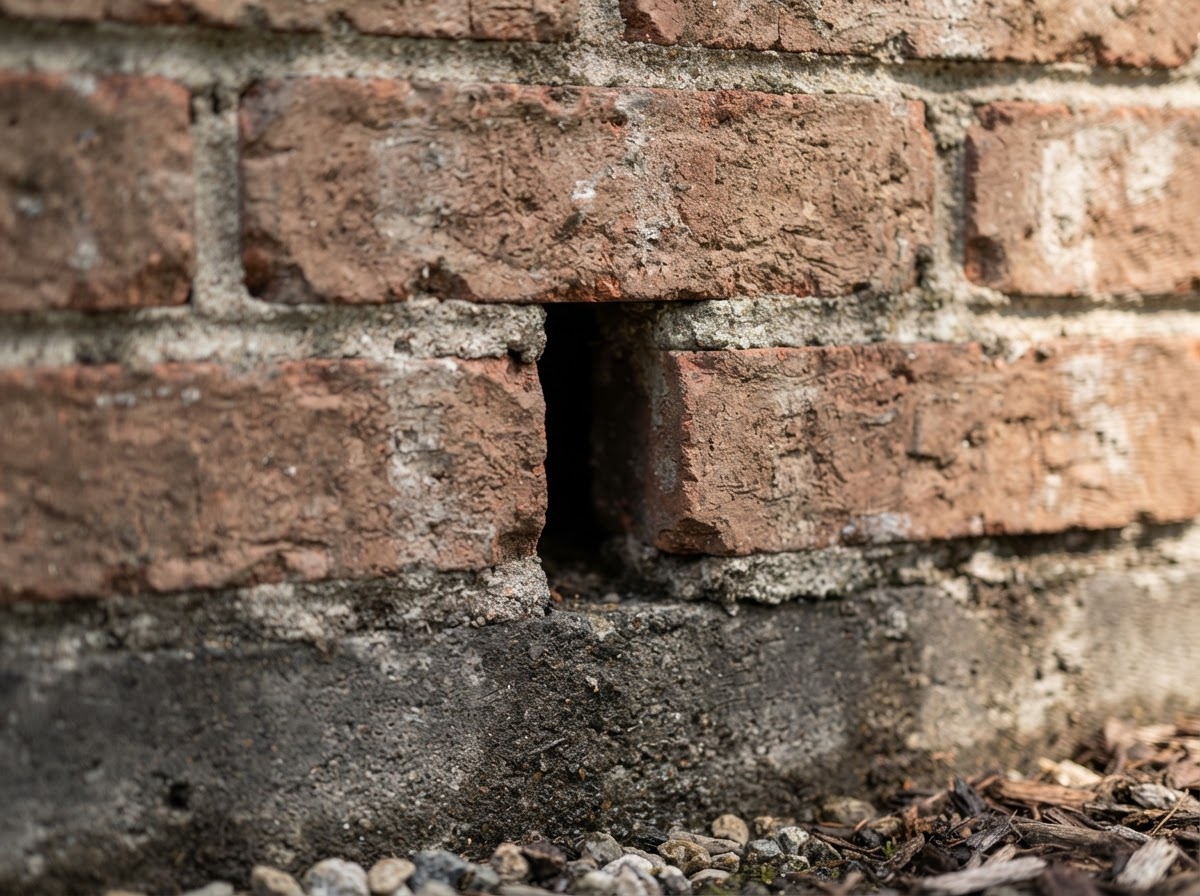
Weep holes in brick veneer and small foundation gaps where rodents squeeze inside.
The rule of thumb: a rat can pass through an opening the size of a quarter, and a mouse through one the size of a dime. That is a much smaller gap than most people picture.
- Weep holes in brick veneer, which nearly every home here has
- Roofline gaps where fascia meets shingles, and at roof returns
- Attic and gable vents with damaged or missing screen
- A/C line set penetrations — where the refrigerant lines enter the wall, frequently sealed with nothing more than a bit of foam
- Plumbing and utility penetrations under sinks, at the water heater, and where cable and electrical enter
- Garage doors — worn bottom seals and the gaps at the bottom corners
- Foundation cracks, which open and close as our clay soil expands and contracts through wet and dry cycles
- Tree limbs, palm fronds, and utility lines giving roof access, which is how roof rats get up there in the first place
- Sewer lines and floor drains, mainly for Norway rats
Why Poison Alone Doesn't Solve It
Bait is the cheapest thing a company can do and it is what a lot of low-cost rodent service amounts to. It has real problems.
- The rodent dies where it is, which is inside your wall or attic. You then have a dead animal problem in a place nobody can reach, and the odor runs for weeks.
- It does not close anything. As long as the entry points are open, the ones you killed are replaced by the ones outside.
- Secondary poisoning. A poisoned rodent that gets eaten puts cats, dogs, hawks, and owls at risk — including the barn owls and hawks that were reducing your rodent population for free.
- It leaves the fleas and mites behind. Those do not die with the host, and they start looking for a new one.
Bait has a place in some situations. As a standalone answer to rodents in a house, it moves the problem rather than solving it.
Rats or Squirrels?
These get confused constantly because both end up in attics. The difference is time of day.
Squirrels are active in daylight, heaviest around dawn and late afternoon, and they sound quick and light. Rats work at night, on and off through the dark hours, and stay more inside wall voids and along joists.
If the noise is strictly daytime, see squirrel removal. If it is heavy enough to sound like something walking around up there, that is a different animal again — see wildlife and critter removal or raccoon removal. For insect issues that might be drawn to rodent droppings, see general pest control.
Health Considerations
Rodents bring more into a structure than the animal itself.
Rodent droppings and urine contaminate insulation and accumulate in enclosed spaces. Dry droppings should not be swept or vacuumed, because that puts particles into the air you are breathing. The safer approach is to dampen the area first and use proper protection, which is part of why cleanup is worth doing correctly.
Rodents also carry fleas and mites. Murine typhus, which is spread by fleas carried on rodents and opossums, has been an ongoing concern in South Texas specifically, which makes flea carryover a more relevant consideration here than it is in a lot of the country.
If anyone has been bitten, or if you are concerned about exposure, contact a doctor rather than waiting it out.
Chewed wiring is the other consideration. Rodent incisors grow continuously and wire insulation is a common target, which makes it a fire risk and the damage you are least likely to notice on your own.
What Doesn't Work
- Ultrasonic repellers. No dependable effect. Rodents acclimate quickly.
- Peppermint oil, mothballs, and dryer sheets. These circulate endlessly online and do not clear an established population.
- A cat. A good mouser helps at the margins and will not resolve an infestation, and cats are one of the animals at risk from rodent fleas.
- Steel wool by itself. It rusts out and it is not a permanent seal. It works as part of a properly finished repair, not as the repair.
- Glue boards. They catch some rodents, they frequently catch things you did not intend, and a rat can drag one into a wall void and die there.
- Sealing the house while rodents are inside. You have to remove the population first, or you have trapped them in with you.
How Steve Handles Rodents
- Inspection, inside and out. Interior activity, attic, crawlspace, the full exterior perimeter, and the roofline — including what is giving roof access.
- Identifying the species. Roof rat, Norway rat, or mouse. This determines where traps go and what gets sealed first.
- Mapping the entry points. All of them, not just the obvious one, and documenting what is found.
- Strategic trapping. Placement on actual runways and travel routes rather than scattered around the attic, which is the difference between catching the population and catching a few.
- Exclusion. Sealing with steel and appropriate materials that rodents cannot chew through, at every opening rather than the largest one.
- Sanitation and harborage guidance. What on the property is feeding them or sheltering them.
- Cleanup. Droppings, nesting material, and contaminated insulation where needed.
- Follow-up monitoring. Confirming activity has actually stopped rather than assuming it has.
Keeping Them Out
- Trim tree limbs and palm fronds back from the roofline — this is the highest-value single step against roof rats
- Screen weep holes with material designed for the purpose
- Seal the A/C line set penetration properly
- Replace worn garage door seals and close the bottom corners
- Pick up fallen pecans, citrus, and other fruit
- Bring pet food in at night and store feed in sealed containers
- Move bird feeders away from the house or remove them while you have an active problem
- Keep firewood and stored material off the ground and away from the walls
- Secure trash and compost
What Rodent Control Costs in San Antonio
Pricing depends on the size of the population, how many entry points need sealing and how difficult they are to reach, whether the work is interior, exterior, or both, whether cleanup and insulation work are involved, and how many follow-up visits the situation calls for. Sealing a handful of weep holes is a different job than a roofline with multiple openings and an attic that needs remediation.
Steve gives you a number after inspecting, along with what is included and what is separate.
Rodent Control FAQ
Hearing Something in the Walls at Night?
Nighttime scratching in the walls or above the ceiling, droppings along a baseboard, or fresh gnawing around a pantry all point the same direction. Steve can identify what you have, find how they are getting in, and seal the house so the next one stays outside.