
Squirrel Removal in San Antonio, TX
Out of the attic, sealed out with steel, and kept from chewing their way back.
If the noise in your attic happens during the day, it is almost certainly squirrels. That one detail rules out most of the alternatives before anyone climbs a ladder. San Antonio's mature oak and pecan neighborhoods are ideal squirrel habitat, and a roofline within jumping distance of a limb is effectively an invitation. The part that matters is what they do once they are inside, which is chew.
Signs It's Squirrels and Not Rats
- Daytime activity. This is the clearest indicator. Squirrels are active in daylight, heaviest around dawn and again in the late afternoon. Rats and mice work at night.
- Fast and light. Quick scampering across the ceiling rather than the heavy thumping of a raccoon removal or the slow scratching of a rodent control problem in a wall void.
- Rolling sounds. Squirrels cache acorns and pecans, and moving them around produces a distinct rolling noise nobody expects the first time they hear it.
- A round chewed hole, roughly two inches across, usually at a roofline corner, a fascia board, or a gable vent.
- Gnawing you can hear. Squirrel incisors grow continuously and have to be worn down, so chewing is constant rather than occasional.
- Droppings that are barrel-shaped with rounded ends. Rat droppings taper to a point at one or both ends.
- Nesting material — leaves, twigs, shredded bark, and pulled-apart insulation.
- Squirrels on the roofline running the same route at the same times of day, often along a fence, a limb, or a utility line.
Where Squirrels Get In
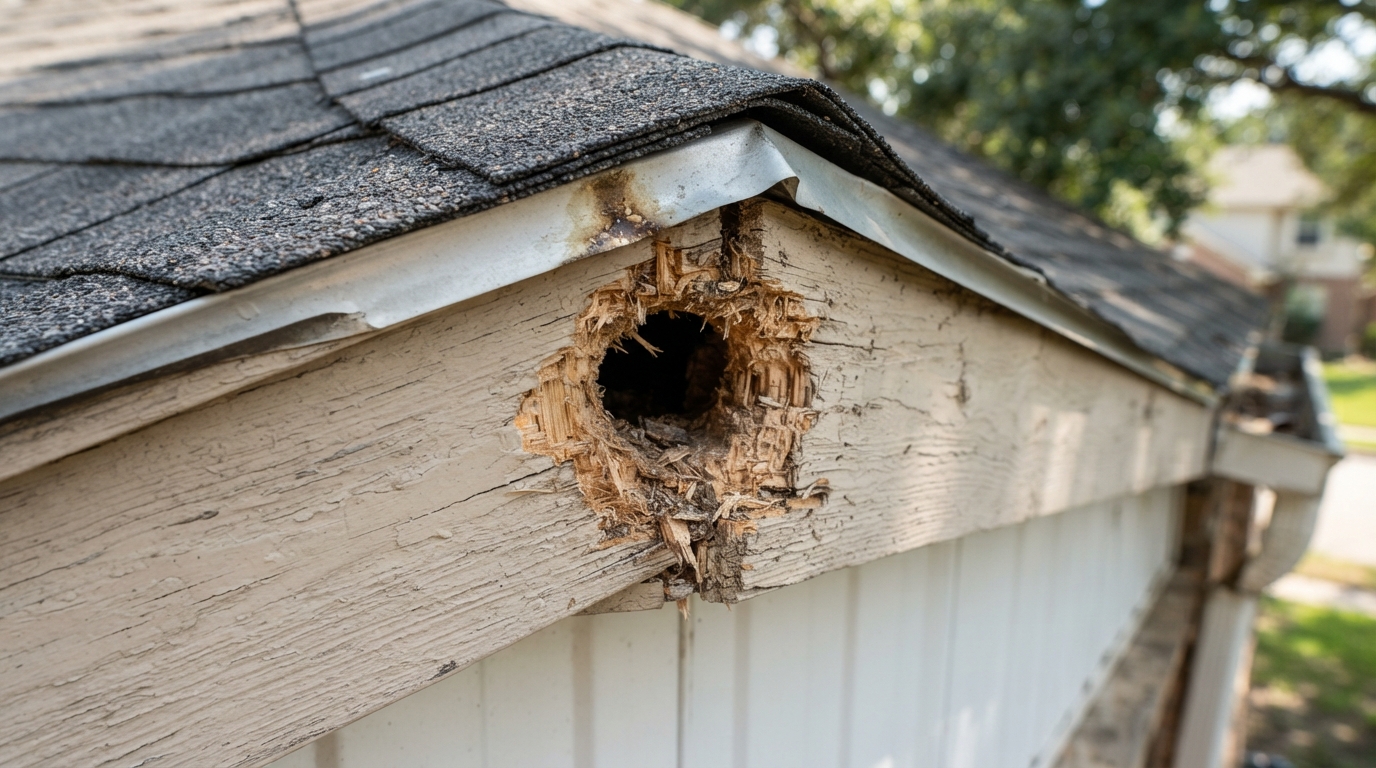
A typical round chewed entry point at a fascia corner where squirrels access the attic space.
- Roofline corners where the fascia board meets the shingles, which is the single most common entry point
- Gable and soffit vents, chewed through the screen or between the louvers
- Soft or rotted fascia and trim, which gives them a head start
- Roof returns and dead valleys, where framing leaves a void behind the trim
- Turbine and attic vents with damaged flashing
- Chimneys without a cap
- Anywhere a limb reaches the roof. A branch within jumping distance is the road in, and squirrels will use the same route daily.
Two Litters a Year, Not One
Most people assume baby season is spring. For squirrels in this part of Texas there are two — one in late winter into early spring, and a second in mid to late summer. Young stay in the nest for weeks before they can leave on their own.
That doubles the window where sealing an entry point too early traps dependent young inside a wall or attic. It also means a summer squirrel call is just as likely to involve a litter as a February one, which is not what most homeowners expect.
Checking before sealing is the part that keeps a squirrel job from turning into a dead animal removal.
The Wiring Problem
This is the reason squirrels are worth handling quickly rather than living with.
Squirrels have to gnaw continuously because their incisors never stop growing, and wire insulation is exactly the right hardness for the job. Stripped wiring in an attic is a fire risk, and it is the damage homeowners find last, because nothing about it is visible or audible from inside the house.
The noise overhead is annoying. The chewing you cannot hear is the actual problem.
Why Sealing the Hole Is Not Enough
Closing up the opening while squirrels are inside produces one of two outcomes, and neither is good. Either they chew a new hole — which they are entirely capable of doing, often within hours — or they do not, and you have animals dying inside a wall cavity.
There is also rarely just one opening. Squirrels typically maintain a primary entrance and one or more secondary routes, and sealing only the obvious one leaves the rest available.
The method that works is closing every secondary opening first, then fitting a one-way door on the primary entrance so the squirrels can leave and cannot return, then permanently sealing that opening once the space is confirmed empty. That sequence only applies when there are no dependent young, which is why the check comes first.
What Does Not Work
- Mothballs and ammonia. Widely repeated online, reliably ignored by a squirrel that has already nested.
- Ultrasonic repellers. No dependable effect.
- Poison. A poisoned squirrel dies where it is, which is inside your attic or wall, and it creates a secondary risk for pets and for the hawks and owls that would otherwise be helping you. This is not how squirrels should be handled.
- Patching with foam, caulk, or wood. Squirrels chew through all three. Sealing that holds has to be steel — hardware cloth, sheet metal, or steel flashing.
- Trapping one and calling it done. There is usually more than one, and the opening is still there for the next.
How Steve Handles Squirrels
- Full inspection. Attic interior, entire roofline, every vent, and the trees and structures that give access to the roof.
- Determining whether young are present. Twice a year this is the deciding factor in how the job is sequenced.
- Sealing secondary openings. Every route except the primary one, closed with steel that squirrels cannot chew through.
- One-way door on the main entrance. Lets the squirrels out and prevents re-entry, without trapping anything inside.
- Confirming the space is empty, then permanently sealing the last opening.
- Cleanup. Nesting material, droppings, and contaminated insulation.
- Follow-up. Verifying activity has stopped and no new chewing has started.
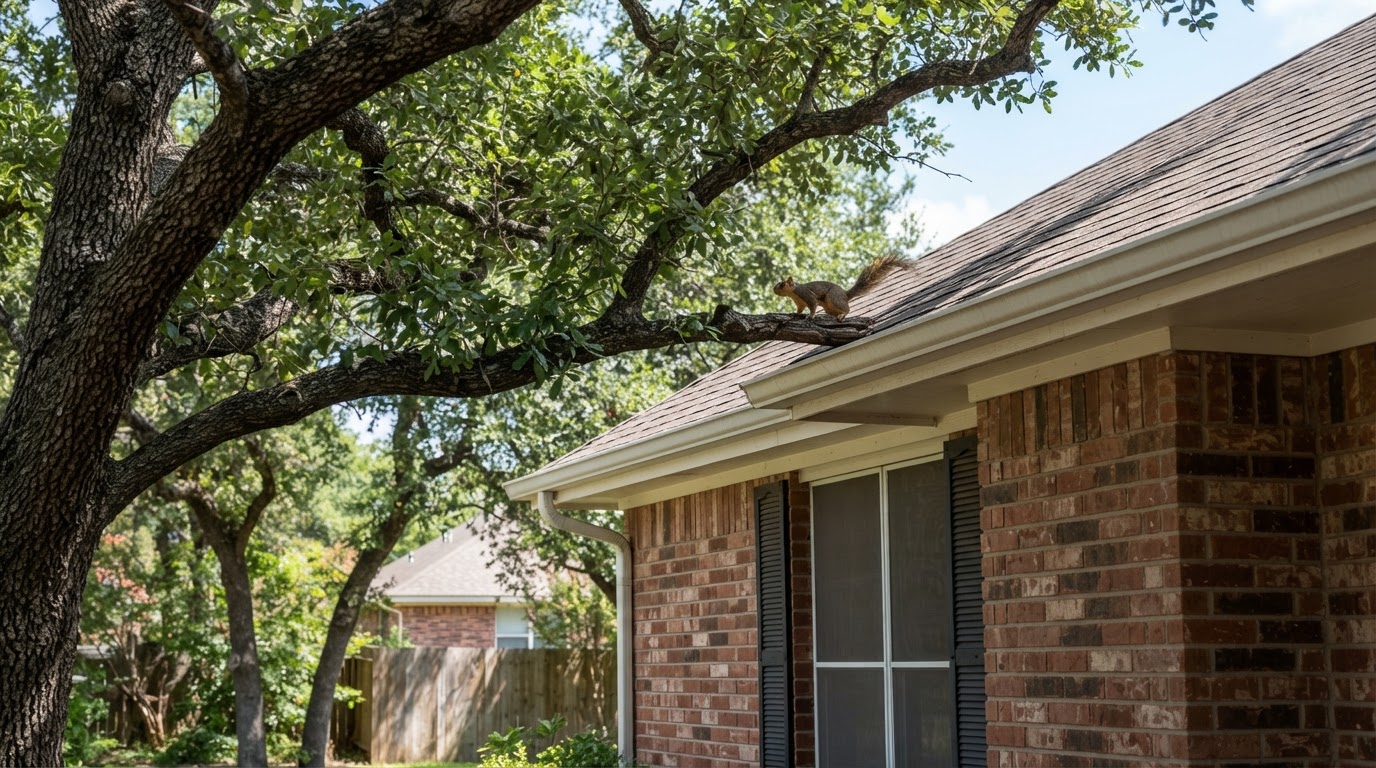
Overhanging limbs provide squirrels an easy bridge directly onto your roofline.
Steve will also point out which tree limbs are giving access to the roof. Trimming those back is worth doing, though it is usually a job for an arborist rather than a pest technician.
Damage Squirrels Leave Behind
- Chewed wiring, which is the most serious and the least visible
- Insulation shredded for nesting and contaminated with droppings and urine
- Fascia, soffit, and trim chewed at the entry point and around it
- Ductwork gnawed or pulled apart
- Water and irrigation lines, occasionally
- Vent screens and flashing damaged during entry, which becomes a leak
- Fleas, mites, and ticks left behind in the space after the squirrels are gone
Wildlife damage is excluded from many homeowners policies. Worth reading yours rather than assuming.
What Squirrel Removal Costs in San Antonio
Pricing depends on how many openings need sealing, how much of the roofline is involved, whether young are present, how much material the repairs require, and whether cleanup is needed. One chewed hole at a fascia corner is a straightforward job. A roofline with several entry points and chewed trim across multiple sections is a larger one.
Steve gives you a number after inspecting, along with what is included and what is separate.
Squirrel Removal FAQ
Hearing Something in the Attic During the Day?
Daytime noise overhead, a round chewed hole at a roof corner, or squirrels running the same route along your roofline every morning all point the same direction. Steve can confirm it, check whether there are young, and seal the roofline so it stops happening. For other wildlife and critter removal or rodent control issues, he can help with those too.