
Wildlife Exclusion & Entry Point Sealing in San Antonio, TX
Finding every way in — not just the obvious one — and closing it with something that holds.
A lot of people find this page after already paying someone once. The animal was removed, a hole got patched, and a few weeks or a few months later the noise came back. That outcome is common enough to be predictable, and it almost always traces to one of two things.
Why Exclusion Work Fails
There are really only two reasons an animal gets back into a house that was supposedly sealed.
Nobody found the actual entry point. They closed the hole that was easy to see and missed the ones that mattered.
The material was not up to the animal. Something got stuffed into an opening that a rat could chew through or a raccoon could pull out.
Everything below is about avoiding those two failures. They account for nearly every callback in this line of work.
Reason One — Nobody Found the Real Entry Point
Animals rarely maintain one route. There is usually a primary entrance and one or more backups, and sealing the obvious one just moves traffic to the others.
Finding the rest is not guesswork, but it does require doing the parts of the inspection that get skipped:
- No height limit. Steve does the roof work himself, two-story included. This matters more than it sounds — a lot of exclusion inspections quietly stop at whatever is reachable from a ladder set on the ground, and the openings that get missed are the ones higher up.
- Getting on the roof. A large share of entry points on San Antonio homes are only visible from above — roof returns, drip edge gaps, where two roof planes meet, and damage at the shingle line.
- Getting into the attic and looking outward. With the attic lights off in daylight, openings show up as pinholes and slivers of light against the sheathing. This finds gaps that are invisible from the ground and invisible from the roof.
- Reading the rub marks. Animals using a route repeatedly leave dark, oily smudges at the opening and along the beams and joists they travel. Those marks tell you which openings are active and which are old.
- Checking the penetrations nobody checks. The A/C line set entry, dryer vent flapper, cable and electrical entries, plumbing chases. These are the openings homeowners have never looked at and cheaper inspections do not bother with.
- Walking the full perimeter, not the side of the house where the noise was reported.
An inspection done from the driveway finds the hole you already knew about.
Reason Two — The Materials Weren't Up to the Animal
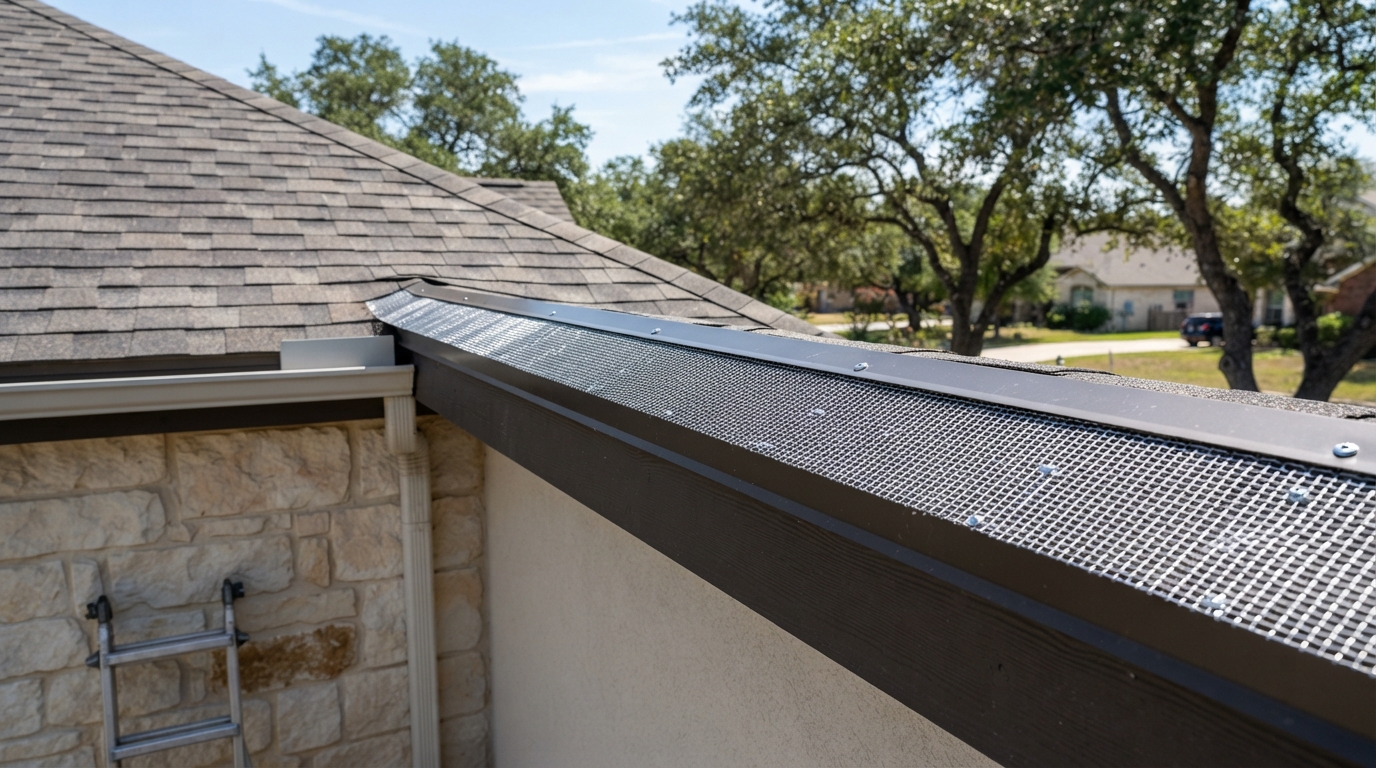
Proper exclusion uses heavy-gauge steel and metal mesh mechanically fastened to resist gnawing and prying.
The second failure is using something that looks like a repair but does not function as one.
Expanding foam by itself gets chewed through in a night. Caulk by itself does the same. Steel wool pushed into a gap gets pulled back out, and it rusts. A wood patch stops nothing that has teeth.
Two principles govern whether a seal actually holds:
- It has to be something the specific animal cannot get through — cannot chew, cannot tear, cannot push aside, cannot pry. That standard is different for a mouse than for a raccoon.
- It has to be fastened, not stuffed. Anything simply pressed into an opening is a temporary measure. A seal that lasts is mechanically attached to the structure.
The right material depends on the opening, the surface it is attaching to, and what animal it needs to stop. Steve picks it per job rather than using the same thing everywhere, which is part of the difference between work that holds and work that looks finished.
Different Animals, Different Standards
This is the part that explains why a house can be "sealed" and still have a problem. Sealing to one animal's standard leaves other animals a way in.
| Animal | Smallest opening it needs | What the seal has to resist |
|---|---|---|
| House mouse | About the width of a dime | Chewing |
| Rat | About the width of a quarter | Sustained chewing |
| Bat | Under half an inch, including long thin gaps | Squeezing through narrow slots |
| Squirrel | An inch and a half, and they enlarge what they find | Persistent chewing at the edges |
| Raccoon | Three to four inches, and they create their own | Pulling, prying, and body weight |
| Skunk and opossum | Ground-level gaps | Digging underneath |
A house sealed against raccoons can still be wide open to rats. A house sealed against rats can still be open to bats, because bats need less room than most people believe.
What a Real Exclusion Inspection Covers
- Roofline — fascia and shingle junction, roof returns, dead valleys, drip edge
- Soffit panels, soffit vents, and the joint where soffit meets wall
- Gable, turbine, and ridge vents
- Chimney, crown, and cap
- Weep holes in brick veneer
- A/C line set penetration
- Plumbing, electrical, and cable entries
- Dryer vent and its flapper
- Garage door bottom seal and the gaps at both bottom corners
- The junction where an attached garage meets the house
- Foundation cracks, which open and close as our clay soil moves through wet and dry cycles
- Crawlspace vents and access doors
- Deck skirting, porch framing, and the space under sheds
- Tree limbs, palm fronds, and utility lines giving roof access
How Steve Does Exclusion Work
- Full exterior inspection, including the roof at whatever height it sits, not just what is reachable from the ground.
- Attic inspection from the inside, looking for daylight and rub marks that identify active routes.
- Confirming nothing is still inside. Sealing a structure with an animal in it creates a dead animal problem in a place nobody can reach. This is checked before anything gets closed.
- Checking for young, since seasonal timing changes the sequence of the entire job.
- Sealing every opening found, with material matched to the opening and the animal, mechanically fastened.
- Attic restoration where it is needed — removing contaminated insulation and nesting material, and replacing insulation.
- Follow-up verification, confirming activity has stopped rather than assuming it has.
Attic Restoration
Insulation that has been trampled, nested in, and contaminated with droppings and urine does not recover. It loses its R-value from compression and it holds odor that keeps drawing animals back to the same spot.
Steve handles insulation removal and replacement where the condition of the attic calls for it. Whether it is needed depends on how long the animals were in there and how much of the space they used — sometimes it is a section, sometimes it is the whole attic, and sometimes the insulation is fine and does not need touching.
When Exclusion Happens
Most of the time exclusion is part of a wildlife and critter removal job rather than a separate service. The animal comes out, the openings get closed, and the two are priced together as one piece of work.
If a previous company removed the animal and the sealing did not hold, that is worth a conversation. Steve can inspect what was done and tell you what is actually open. For more specific information, see our pages on squirrel removal, raccoon removal, and rodent control.
What Exclusion Costs in San Antonio
Pricing depends on how many openings there are, where they are and how hard they are to reach, what materials the situation requires, whether the roofline itself needs repair, and whether attic restoration is part of the job. A few sealed weep holes and a full roofline are different work.
Because exclusion is usually bundled with removal, the price reflects the whole job rather than a line item. Steve breaks down what is included after inspecting.
Exclusion FAQ
Did They Come Back?
If you have already had an animal removed and the noise started again, the problem is not that the animal is unusually determined. It is that something was missed or something did not hold. Steve can inspect what was done, find what is still open, and tell you what it takes to close it properly.